You’re tired. Not just “long day” tired, but “constantly running to keep up with the next big thing” tired. Every week, another “revolutionary” AI tool promises to change everything, usually by adding another subscription and demanding more of your precious time.
The reality: Most of this “innovation” feels like extra homework. You’re drowning in tools that are either too complex, too general, or just plain hype. You want AI to make you lazier, not busier. You want to simplify, automate, and humanize your work, but AI often feels like it’s doing the opposite.
The “Hustle” Way (And Why It’s Broken):
The prevailing advice is to become a “prompt engineering guru” or manually integrate a dozen disparate AI tools. You spend hours watching tutorials, tweaking prompts, and trying to force-fit generic AI into your specific workflow.
This brute-force approach turns AI into another demanding job. You’re constantly context-switching, fact-checking every AI output, and acting as a glorified orchestrator for tools that should be working for you.
Why it fails: It prioritizes being “busy with AI” over being effective. It misses the fundamental point of automation: to reduce your effort and cognitive burden, not just shift it around. It leads to burnout and cynicism, eroding the very benefits AI promises.
The “Lazy” Way (The Core Framework): The 3 Pillars of Strategic Laziness with AI
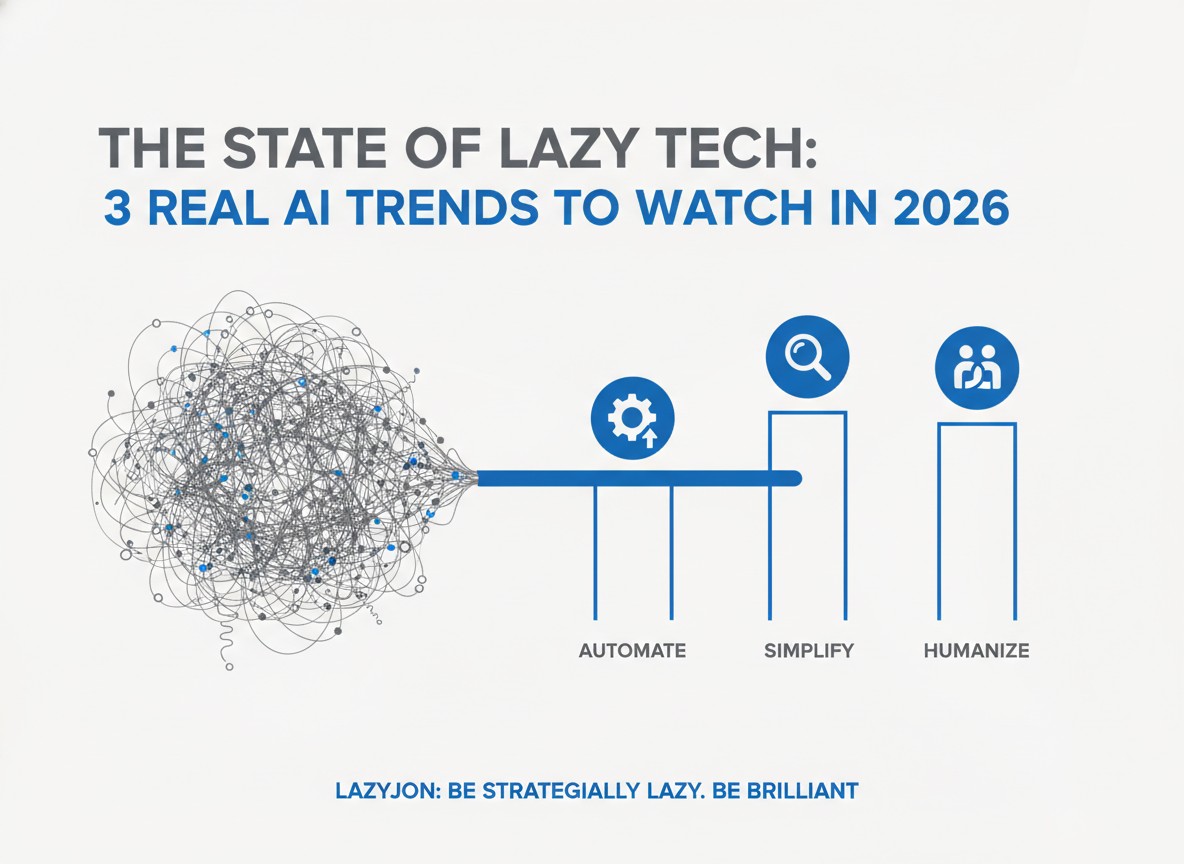
In 2026, the smart move isn’t to work harder with AI, but to strategically delegate to it. It’s about making AI disappear into your workflow, working autonomously in the background, freeing you for high-value human endeavors.
Pillar 1: Agentic AI for True Delegation(Automate)
This isn’t just a chatbot; it’s AI that understands a goal, designs a multi-step plan, and executes it with minimal human intervention. Think of it as a virtual assistant capable of running entire micro-projects, from market research to drafting complex reports.
LazyJon Angle: You set the objective, the agent handles the heavy lifting. Your role shifts from “doer” to “director,” giving you back hours of tactical execution.
Pillar 2: Niche-Specific AI Tools(Simplify)
Forget general-purpose AI for every task. The real game-changers are highly specialized AI tools designed for your specific industry or role. Legal drafting, medical transcription, financial analysis, code generation – these tools are trained on proprietary data, speak your professional language, and integrate seamlessly.
LazyJon Angle: These tools cut through the noise by being purpose-built. Less fiddling with generic prompts, more instant, accurate, and relevant outputs. They simplify complex domain tasks by becoming an extension of your expertise, not a distraction from it.
Pillar 3: Human-AI Co-Piloting & Hybrid Skills(Humanize)
AI isn’t here to replace you entirely; it’s here to augment you. 2026 is about mastering the art of human-AI collaboration. AI handles the data, the patterns, the repetitive, and the first drafts. You bring the creativity, the strategic judgment, the emotional intelligence, and the uniquely human connection.
LazyJon Angle: You reclaim your uniquely human value. By offloading the mechanical, you double down on what makes you irreplaceable. The AI becomes your tireless partner, allowing you to focus on the impactful, engaging, and genuinely human aspects of your work.
Putting It Into Practice (The How-To):
- Map Your “Delegate-ables”: For one week, track 3-5 tasks you dread or that consume excessive time but don’t require your unique human insight. These are your prime candidates for agentic AI delegation. Think processes, not just single actions.
- Audit Your Niche AI Landscape: Instead of browsing general AI lists, search for AI tools specifically within your industry or role (e.g., “AI for [Your Profession]” or “Automation for [Your Niche]”). Pick one promising tool and commit to exploring its deep features.
- Practice “Oversight, Not Creation”: When using any AI, shift your mindset from “how do I make it do this?” to “how do I define the outcome and critically evaluate its attempt?” Train yourself to refine outputs and provide higher-level direction, rather than meticulously crafting every prompt.
- Invest in Your “Un-AI-able” Skills: Dedicate time each week to develop skills that AI struggles with: complex critical thinking, nuanced emotional intelligence, genuine relationship building, and innovative problem-solving. These are your career superpowers in an AI-powered world.
The Payoff (The “Why It’s Worth It”):
By embracing strategic laziness, you stop being a cog in the machine and become a master of leverage. You drive greater impact with less direct effort.
Imagine getting back hours from your week not to work more, but to think more, live more, and engage with the work that truly matters to you.
You won’t be replaced by AI because you’ll be the one directing it. You become an indispensable leader of hybrid human-AI teams, shaping the future of work on your terms.