Getting Big Tech companies to agree on an open standard is usually impossible. Imagine trying to get Microsoft and Amazon to cooperate on a universal connector.
But something monumental happened last week.
The Linux Foundation announced the formation of the Agentic AI Foundation (AAIF), and the list of backers isn’t just a few startups. It is effectively every major player in the industry, all agreeing to build the Agentic AI future on a shared, open infrastructure. This move toward interoperability is the most significant development for AI agents this year.
Platinum Members: The List of Companies Standardizing Agentic AI
If you are skeptical that this is just another paper tiger, look at the roster. This isn’t a side project; it is a verified consortium dedicated to creating Agentic AI standards.
According to the official Linux Foundation announcement, the Platinum Members supporting this foundation include the biggest names in the AI ecosystem:
- Microsoft
- Amazon Web Services (AWS)
- OpenAI
- Anthropic
- Bloomberg
- Cloudflare
- Block
Why this matters: When giants like Google, OpenAI, and AWS all sit at the same table to fund the same standard, they aren’t competing on how agents connect. They are agreeing that the essential plumbing for Agentic AI should be universal and open-source.
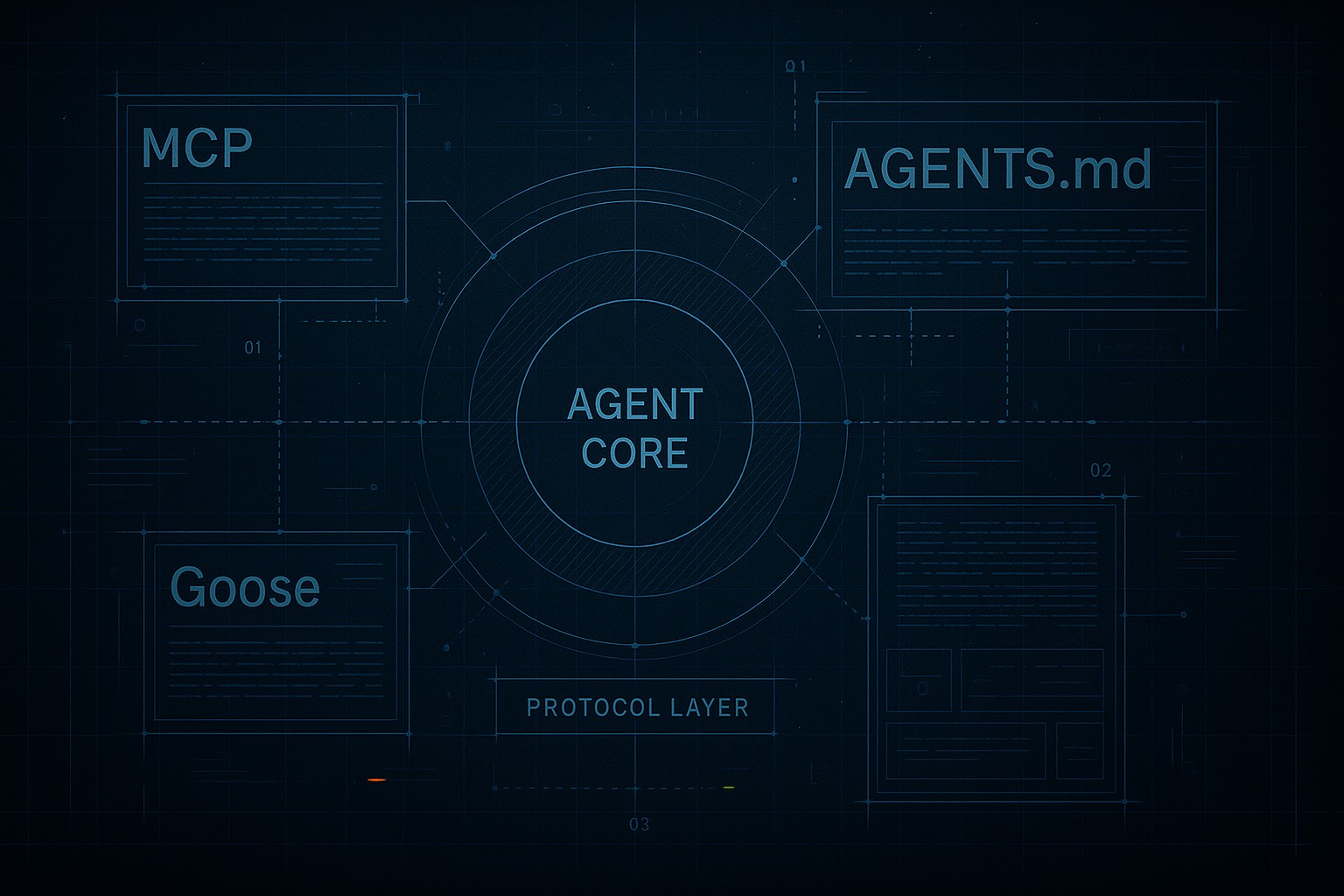
The Three Core AAIF Open Standards: MCP, AGENTS.md, and Goose
The Agentic AI Foundation isn’t starting from scratch. It is launching with three mature technologies donated by the founders to solve the three biggest friction points in autonomous agent deployment:
- The Connection (Model Context Protocol, or MCP): Donated by Anthropic. Think of the Model Context Protocol as the “USB-C for AI.” It standardizes how any large language model (LLM) connects to data sources like GitHub, Google Drive, or Slack. You build the data connector once, and it works seamlessly for Claude, ChatGPT, and Gemini.
- The Instructions (AGENTS.md): Donated by OpenAI. This is essentially a
robots.txtfor the agent era. It is a standardized file format that lives in your codebase, telling autonomous agents exactly how to behave, what to refactor, and what to leave alone. Source: OpenAI - The Engine (Goose): Donated by Block. An open-source, local-first agent framework that actually runs the tasks. It allows developers to run safe, reliable agentic workflows on their own machines. Source: Block
The “Lazy Genius” Take on Interoperability
Why should you care about these open standards? Because interoperability is the ultimate efficiency hack.
Before this, building an AI agent meant picking a vendor and hoping you didn’t bet wrong. Now, we are moving toward a world where you build your data connectors once (using MCP) and define your rules once (using AGENTS.md), and they work across every major model.
The industry is building the highway so we don’t have to bushwhack through the jungle every time we want to deploy a new intelligent tool. That is a future I can get behind.